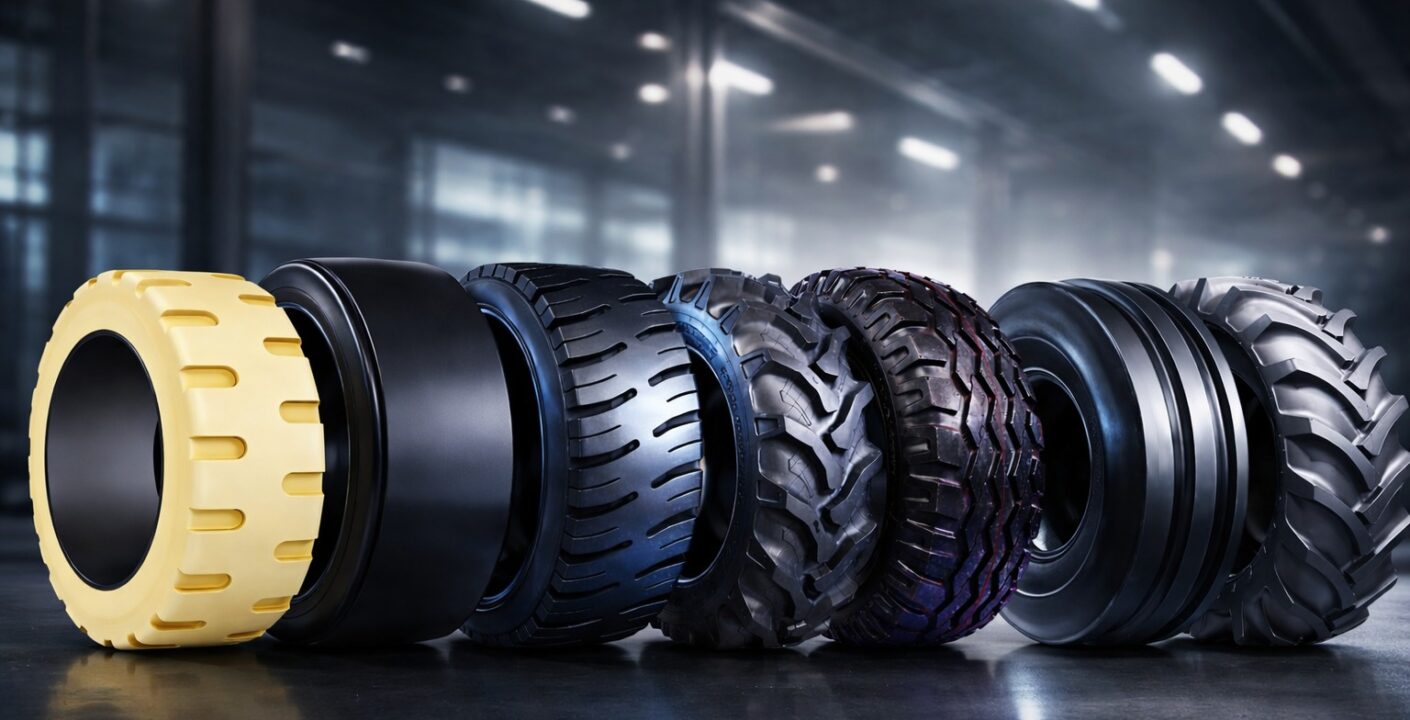
In high-velocity warehouse environments, the price of a tyre is only a fraction of its true cost. In 2026, with the average forklift downtime cost estimated at roughly $700 to $1,000 per hour—and even exceeding $20,000 per hour in massive distribution hubs—the decision to buy “cheap” tyres can quickly become a million-dollar mistake.
Here is the breakdown of the hidden costs that budget tyres bring to your facility and why premium solutions like Faucon’s FIT series are the strategic choice.
1. The “Iceberg” of Downtime Costs
When a forklift stops due to a tyre failure, the repair bill is just the tip of the iceberg. The submerged costs are what drain your profit margins:
- Idle Labor: You are still paying the operator (and often the crew waiting for the load) while the machine sits idle.
- Missed SLAs: In the era of “next-day delivery,” a two-hour delay can lead to missed shipping windows and liquidated damages from clients.
- Overtime Catch-up: To make up for the lost shift, you’ll likely pay 1.5x labor rates later in the week to hit your targets.
2. Why Cheap Tyres Fail Faster
Budget tyres are often manufactured using standard rubber compounds that prioritize low initial cost over structural integrity.
- Chunking and Tearing: On warehouse floors with debris or uneven joints, cheap rubber “chunks” easily. Once a tyre loses its roundness, the resulting vibration damages the forklift’s transmission and mast.
- Heat Build-up: Low-grade rubber struggles with heat dissipation during multi-shift operations. This leads to internal structural failure, often occurring without warning during a heavy lift.
- Rapid Wear: Data shows that while premium tyres can last up to 10,000 hours, budget alternatives often require replacement after just 2,000 to 3,000 hours. You end up paying for the labor of three tyre changes for every one change of a premium tyre.
3. The Structural Solution: FIT Master & FIT Achiever
To combat these costs, Faucon has engineered the FIT Master (Pneumatic) and FIT Achiever (Solid) series. These are designed specifically to eliminate the “cheap tyre trap” through three key innovations:
A. The Reinforced Sidewall
Cheap tyres often deflect under load, causing stability issues. Faucon tyres feature reinforced sidewalls that reduce deflection, protecting the rim and ensuring the operator can turn precisely even with a full load.
B. “Soft-Resilio” Layers
In our FIT Achiever solid tyres, we use a three-layer construction. The middle “Soft-Resilio” layer acts as a shock absorber. This doesn’t just help the operator; it protects the expensive electronic sensors found in modern 2026 electric forklifts from being “shaken to death” by floor vibrations.
C. Advanced Heat Dissipation
Using a customized tread compound, Faucon tyres run cooler. By reducing the thermal stress on the rubber, the tyre maintains its grip and structural shape for thousands of hours longer than budget competitors.
4. The ROI of Quality
Consider a fleet of 20 forklifts. Replacing a $200 budget tyre twice as often as a $400 premium tyre seems like a wash—until you factor in the $1,500 in lost productivity for every hour that forklift is in the shop.
| Factor | Budget Tyres | Faucon Premium Tyres |
| Initial Cost | $200 | $400 |
| Service Life | 2,500 Hours | 8,000+ Hours |
| Replacement Frequency | 3–4 times per year | Once per year |
| Hidden Downtime Cost | $3,000+ (Estimated) | $700 (Scheduled) |
The Verdict
In 2026, efficiency is the only way to stay competitive. Buying a cheap forklift tyre is essentially gambling with your uptime. By switching to a high-performance, heavy-duty range like Faucon, you are investing in the “unsung hero” of your warehouse—the tyre that keeps your operations moving, shift after shift.
0 Comments
This is exactly what i was looking for, thank you so much for these tutorials
It would be great to try this theme for my businesses
What a nice article. It keeps me reading more and more!